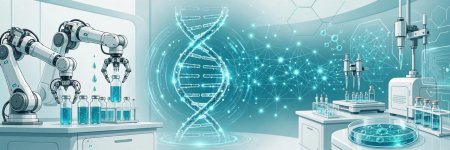
Life sciences company Danaher plans to launch its first AI-powered autonomous research lab early next year, combining artificial intelligence, robotics and technologies from several of its operating companies in a single connected workflow aimed at making drug discovery and development faster and more efficient.
What the lab will do
The lab, projected to operate at scale in early 2027, will be used to develop custom antibodies and other molecular tools. According to the company, it is expected to make discovering molecules eight times faster and unlock a tenfold increase in generating target-binding molecules annually.
The lab uses AI to design new molecules that can bind specifically to a biological target — including antibodies — then builds and tests each one, feeding every result back into the model to improve the next design in a continuous loop.
Why it matters
"That frees them (scientists) to focus on the complex scientific challenges where human insight matters most," said JC Gutierrez-Ramos, Danaher's chief science officer. The lab is part of a broader programme across the company intended to create what it describes as a fleet of smart instruments, signalling a push to embed AI-driven automation deeper into life-sciences research workflows.
The announcement comes as pharmaceutical and biotechnology firms race to pair AI with laboratory robotics to shorten discovery timelines and cut costs — an area where companies with large installed instrument portfolios see a built-in advantage.
Sources: Reuters: Life sciences firm Danaher to launch AI-powered autonomous research lab in 2027
What the lab will do
The lab, projected to operate at scale in early 2027, will be used to develop custom antibodies and other molecular tools. According to the company, it is expected to make discovering molecules eight times faster and unlock a tenfold increase in generating target-binding molecules annually.
The lab uses AI to design new molecules that can bind specifically to a biological target — including antibodies — then builds and tests each one, feeding every result back into the model to improve the next design in a continuous loop.
Why it matters
"That frees them (scientists) to focus on the complex scientific challenges where human insight matters most," said JC Gutierrez-Ramos, Danaher's chief science officer. The lab is part of a broader programme across the company intended to create what it describes as a fleet of smart instruments, signalling a push to embed AI-driven automation deeper into life-sciences research workflows.
The announcement comes as pharmaceutical and biotechnology firms race to pair AI with laboratory robotics to shorten discovery timelines and cut costs — an area where companies with large installed instrument portfolios see a built-in advantage.
Sources: Reuters: Life sciences firm Danaher to launch AI-powered autonomous research lab in 2027